September in the garden: Seasonal jobs with Ashley Edwards

Garden Designer Lucy Willcox

Written by: Crocus Head Gardener Ashley Edwards

September is a time of gentle shifts in the garden. The air takes on a different quality, the earthy scent reminds us that autumn isn’t so far away. Mornings can feel slightly crisp, evenings cooler, and the first few leaves begin to fall (although this has been hastened by the dry weather this year!).

It’s a good time to think about your garden space. How has it looked to you this year? What’s thrived and what's struggled? Is it resilient, or does it require a large amount of labour from you? Perhaps you want to be more hands on and start a new project? September is also a great time to look ahead to next year and plan your spring bulb planting.

I’d like to share with you some projects and ideas for gardening in September.

Pruning

You can prune many of your evergreen shrubs and hedges this time of year. A September prune is more about lightly shaping and tidying than hard formative pruning. What you want to avoid is encouraging lots of new shoots as these can be damaged by the upcoming frosts.

Late flowering shrubs like hardy Hibiscus, Cistus and Abelia, can all be pruned to shape in September. Once the flowers have finished, use clean sharp secateurs or hedge shears to take spent flowering shoots back to the next set of healthy leaves. This will keep the shrub looking neat and encourage bushy growth next year. If you do need to rejuvenate a shrub by performing a hard prune, this is best done in late winter or early spring.

Evergreen hedges like yew, buxus, laurel and holly can also be pruned this time of year. Again, you don't want to do any hard pruning, but instead just take off the soft summer growth to reshape. Use hedging shears for small hedges or topiary or get yourself a pair of battery powered hedge trimmers to make quick work of it. Always check for nesting birds as some species will nest later in the year, it is illegal to disturb a nesting site. Keeping your hedges clipped will create a formal backdrop for other plants, and produce a dense hedge that is good for blocking out noise, pollution and undesirable views.

Some trees can be pruned in September. Birches can benefit from a crown lift now as the flow of sap has slowed down and bleeding is less likely. Hornbeams can also be crowned lifted in September. It’s sometimes easier to see what to remove when the leaves are still on the tree, casting shade. The purpose of crown lifting is to allow light to penetrate under the canopy of the tree, opening up opportunities for underplanting, creating a clear tree trunk and avoiding obstructions. Any dead branches will be more obvious this time of year too, so remove these with a sharp pair of loppers or saw.

If herbaceous plants have flopped over in winds and died back, you can prune these to the ground. Try the chop and drop method where you leave the well chopped material on the soil surface to be composted by microorganisms. Leave any seed heads of grasses, alliums and other structural plants, for winter interest. Resisting the urge to cut and tidy everything also provides essential habitat for insects. If you do need to tidy, do it in sections to allow any creatures the chance to move on.

Cutting & pruning tools

Maintain your garden's pristine condition with our range of high-quality cutting tools. At Crocus, we understand the importance of precise and effective pruning, which is why we offer a wide range of cutting tools designed to meet all your gardening needs.

Shop now

Cutting & pruning tools

Maintain your garden's pristine condition with our range of high-quality cutting tools.

Shop now

Dividing perennials to increase vigour

Dividing perennials to increase vigour

Over time, most perennials lose vigour, become congested and flower less. You'll often see this with herbaceous plants; they form a donut shape, with the older central part of the plant dying off and a ring of new growth growing outward. By digging up and dividing these perennials, you can rejuvenate and move plants to where you want them, filling out your borders and creating plants for free.

The best way to get an even division is to dig up the whole plant, place two forks back to back in the centre of the clump and then lever them apart to split the plant in two. If you have a large rootball you can repeat this process until you have manageable clumps. If the plant is too big to dig up, you can use a sharp spade to slice through and divide the plant. Beware that not all plants like to be divided, and the new divisions may sulk or even fail. Avoid trying to divide plants with a taproot like Baptisia, Eryngium and Japanese Anemone. These plants are better propagated by seed or root cuttings.

Once you have your new clumps, you can decide where you want them, plant and water well. Provide a mulch of composted material and keep watering until established. You can do this every 2-3 years with most plants, meaning you can quite quickly increase your borders!

Autumn is a great time to plant

Autumn is a great time for planting. The soil is still warm, encouraging strong root growth, and autumn rains help to settle plants in. It’s also a good time to notice gaps in your borders as plants begin to die back or lose leaves. You may also be carrying out renovations in autumn, extending borders, digging out or moving established plants, or perhaps dividing herbaceous perennials, giving you space to play with. Over the course of autumn, the plants will establish their root system, harden off in winter, and then be ready to grow in spring.

The spring garden is created in autumn. Bulb planting in autumn is a great way to guarantee colourful displays throughout spring, and bulbs such as daffodils, tulips, crocus, hyacinths and muscari can all be planted starting in September onwards. You can also plant up your containers with spring bulbs and enjoy the anticipation of seeing them push through the soil next year.

Autumn is also a great time to plant bare-root roses, trees and hedging. These plants are best planted as soon as possible, or put into a bucket of water for a day or two before you get around to planting them. The benefits of bare-root plants are that they establish quickly, are cheaper, and have a lower carbon footprint than potted plants. Make sure to keep them watered in their first few years to help them establish.

Plants for Autumn Interest

As the seasons change, it’s a good time to look ahead and think about structure for your autumn/winter garden. There are many different late-flowering plants that will provide interest through autumn, and they are all worth looking into.

Asters

Asters are in the daisy family and have a cluster of central flowers surrounded by a wheel of colourful petals. They come in a range of shades of purple, pinks and white. Eurybia divaricata (white wood aster) is a tough spreading perennial that works really well under trees and tolerates dry shade surprisingly well. Plant asters toward the middle or back of borders for an autumn show.

Cyclamen hederifolium

Cyclamen hederifolium are a great plant for under-planting deciduous trees and shrubs. They have dainty winged flowers that come in shades of pinks and whites. Planted en masse on a bankside or rockery they really brighten up the garden in autumn. The leaves generally emerge after the flowers and look like variegated ivy leaves, hence the species name. They are a tuberous plant and you can usually buy them either as a tuber in spring or as a potted plant in autumn.

Grasses

Late flowering grasses such as Miscanthus, Stipa, Panicum, Calamagrostis, Anemanthele, are all great for autumn interest. Their flower heads sway in the breeze and are often in coppery tones. Leave them standing over winter and cut back in early spring for an extended season of interest.

Asters

Asters

Shop now

Cyclamen

Cyclamen

Shop now

Grasses

Grasses

Shop now

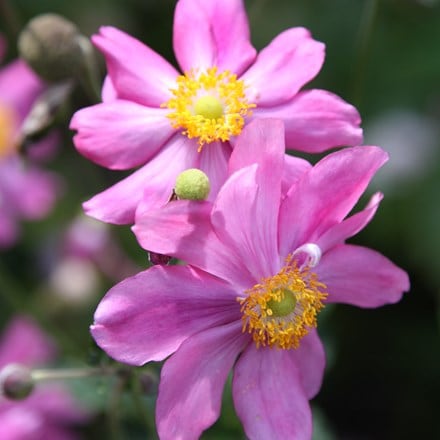
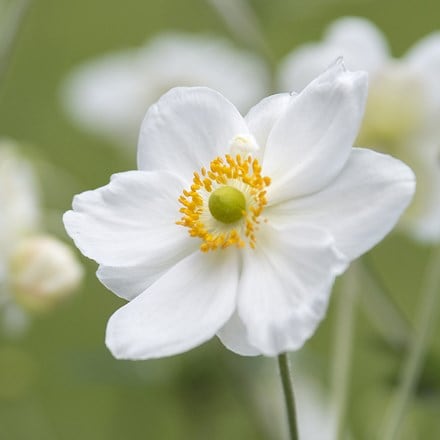
Japanese anemones

Japanese anemones are a real jewel of autumn. They are a versatile plant, suitable for cottage, Japanese and woodland-style planting. Most get quite tall, 50-150cm, so place towards the back of a border and stake in spring if you are on a windy site. They like rich soil and will produce spreading rhizomes. Anemones can be planted as rhizomes or potted plants, they don't like root disturbance and can take a few years to establish. Once they get going, they are tough plants

Sedum (Hylotelephium)

Sedum (Hylotelephium) are a classic autumn-flowering herbaceous perennial. These plants have succulent leaves and flat topped flower heads, often in shades of pink, but also available in white. They are a great, late food source for pollinators. They are drought-tolerant, once established, and easy to look after. Cut back old flowering stems to the ground when you see new shoots emerging from the crown of the plant. Around May, pinch out the shoots, or cut every third shoot to the ground. This will create a bushier plant and prevent them flopping open in the middle.

Evergreen shrubs

Evergreen shrubs add bones to your borders with the use of plants like yew, spindle (Euonymus), myrtle, Mexican orange blossom (Choisya), olive, kohuhu (Pittosporum), bay, mahonia, oleaster (Elaeagnus), viburnum and box (if you're prepared to treat for box moth). Evergreen shrubs can provide an excellent backdrop for your flowering plants and can be used to create divisions in borders. Keep them clipped regularly to prevent them dominating a space or shading out other plants. You can also choose evergreens with variegation or contrasting coloured foliage to add extra interest in winter. Plant these shrubs in autumn to give them the best chance to establish roots during the cooler months. Water in well and mulch with an organic garden compost to retain moisture and suppress weeds.

Japanese anemones

Japanese anemones

Shop now

Sedum (Hylotelephium)

Sedum (Hylotelephium)

Shop now

Evergreen shrubs

Evergreen shrubs

Shop now

Even though the growing season may be slowing down, it’s still an exciting time of year with planning and anticipation for another fantastic year of gardening. Planning now will help you get a step ahead with more time to enjoy and relax in your growing space.