Hedera colchica 'Sulphur Heart'
Persian ivy
- Position: full sun or partial shade
- Soil: humus-rich, preferably alkaline, moist, well-drained soil (or John Innes No3 potting compost for container-grown plants)
- Rate of growth: fast-growing
- Flowering period: October and November
- Hardiness: fully hardy
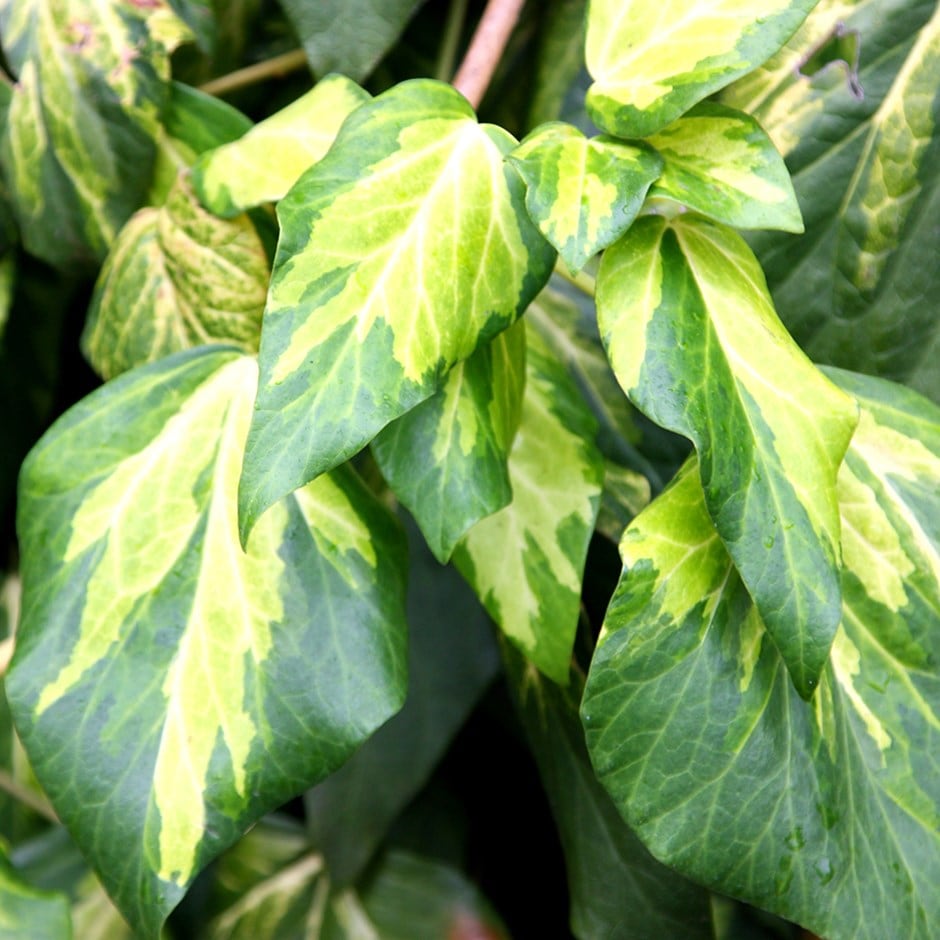
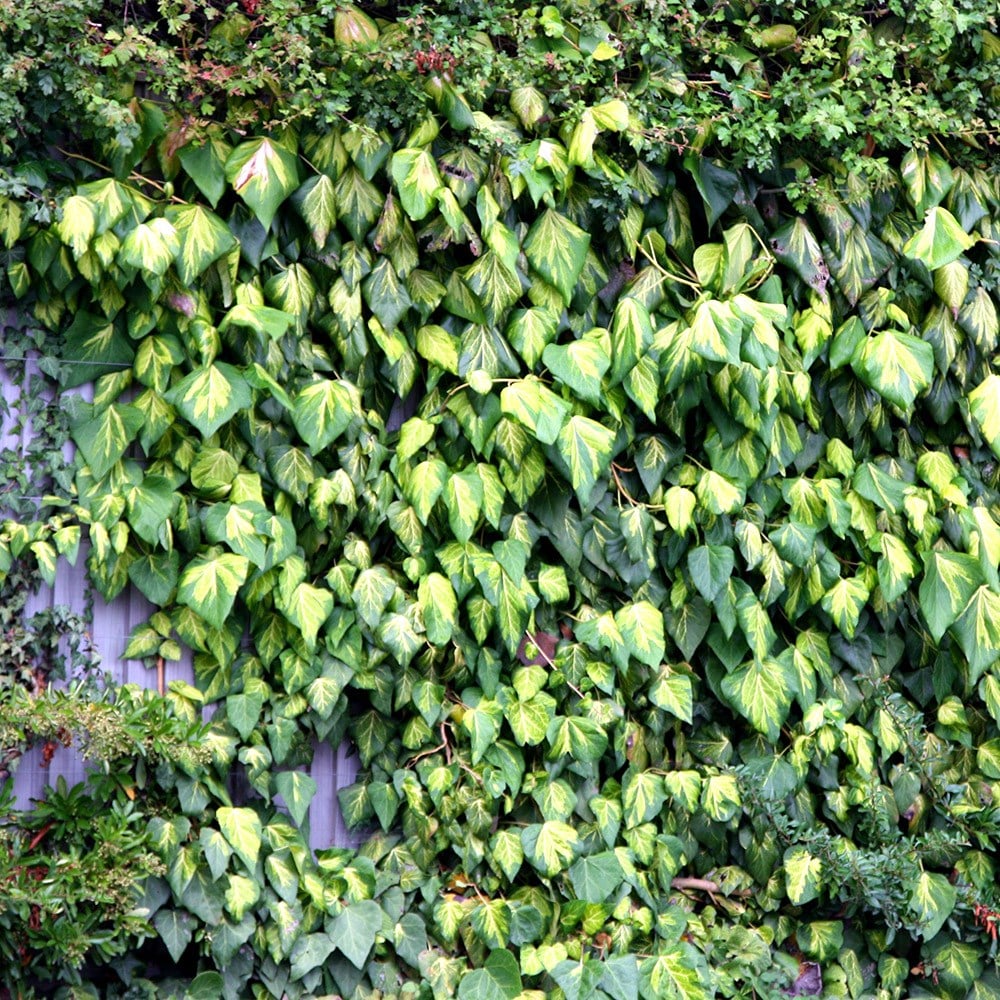
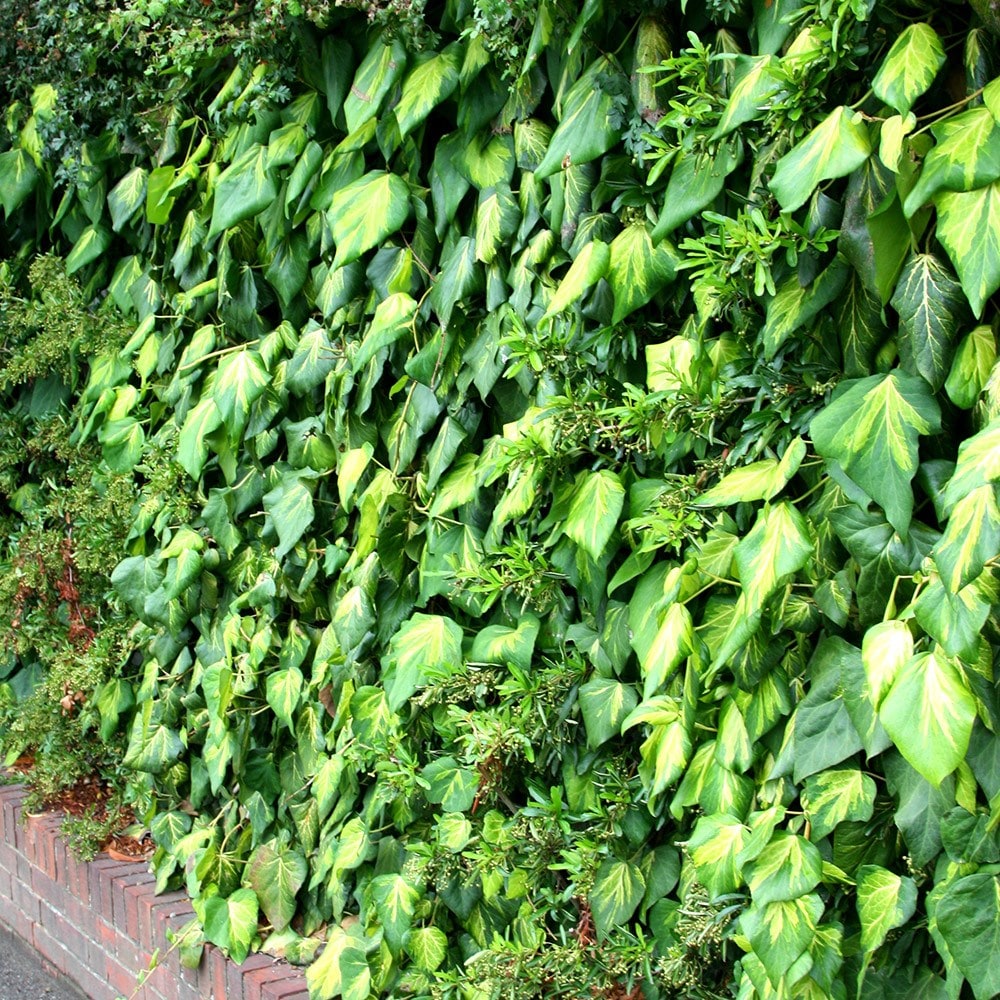
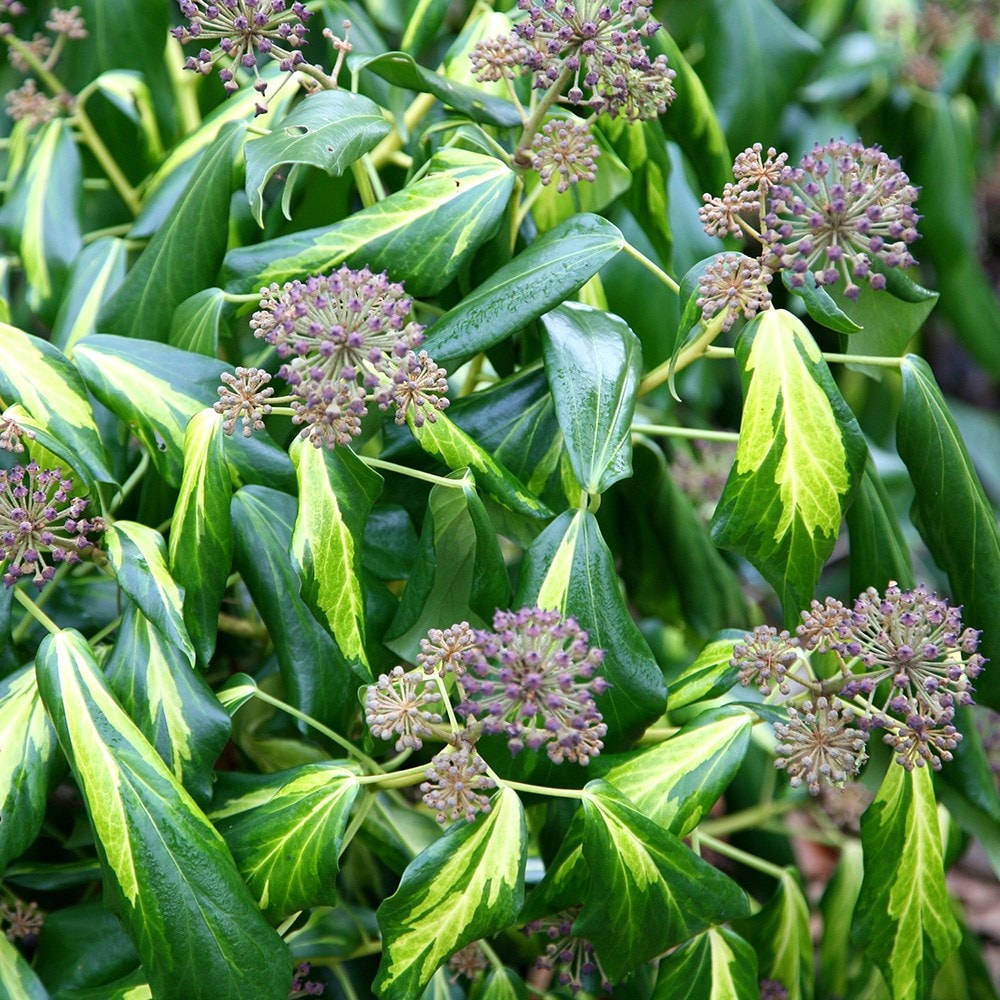
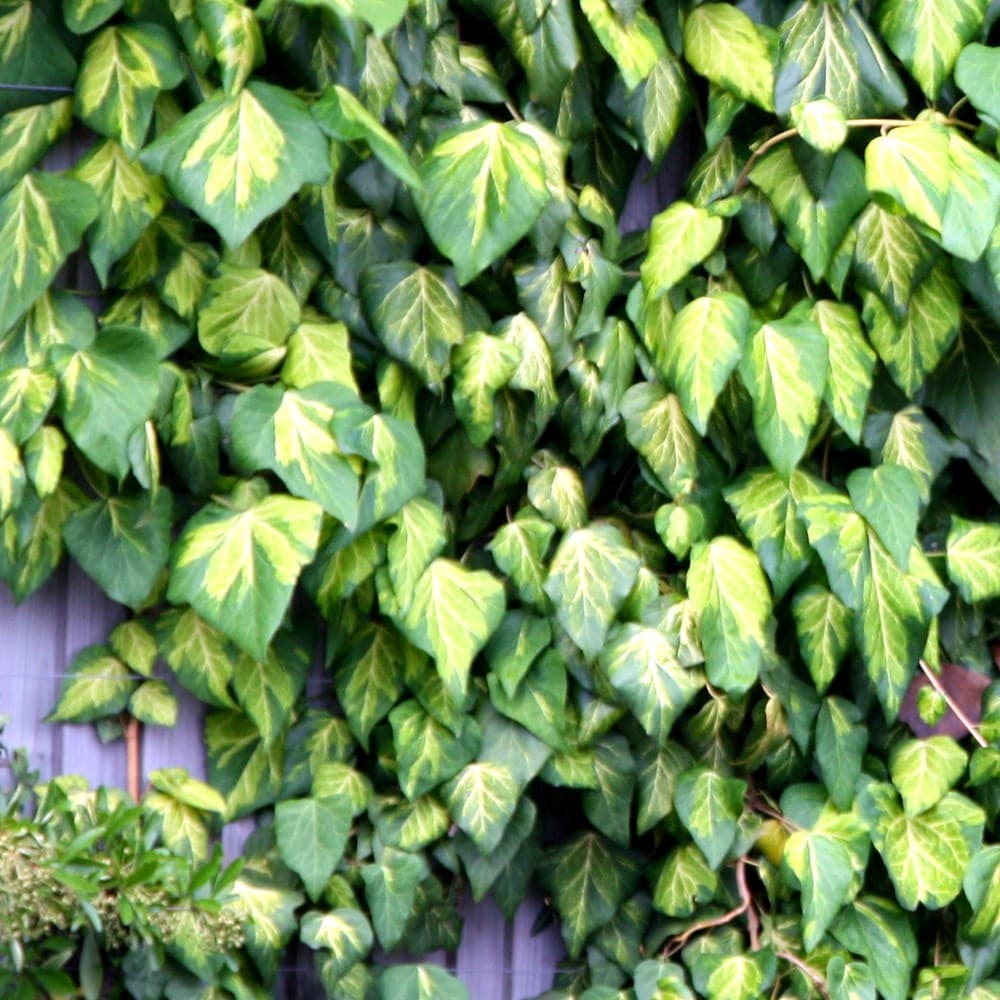
This vigorous, self-clinging, variegated Persian ivy has heart-shaped, mid-green leaves splashed with yellow. As it matures, the variegation of the foliage becomes more pronounced. It is a handsome, self-clinging, evergreen climber suitable for brightening or covering a shady wall or as fast-growing groundcover. Mature plants bear large, spherical green flowers in autumn. It is particularly suited for planting in areas recently cleared of builder's rubble since it prefers alkaline soil. It works best in fertile, moist but well-drained, alkaline soil. - Garden care: Water specimens grown as houseplants regularly during the growing season, providing a balanced liquid fertiliser each month. Keep moist during the winter months. Plants may be pruned at any time of the year to keep within bounds.
- Harmful if eaten/may cause skin allergy
Do you want to ask a question about this?
If so, click on the button and fill in the box below. We will post the question on the website, together with your alias (bunnykins, digger1, plantdotty etc etc) and where you are from (Sunningdale/Glasgow etc). We'll also post the answer to your question!Q:
Climbers for trellis with wildlife considerations
Hi I have a bare trellis at the end of my garden which marks the end of my raspberry and rhubarb beds, and where my composting and comfrey live. I want to cover this trellis with something to give colour all the year round, even if that "colour" is green leaves. I also want to provide something beneficial to the wildlife. I had thought about growing an Ivy, with a Clematis. Would these two climbers work in a small area and would I get my combination of colour, all year interest and wildlife benefits? Thanks MikeAsked on 3/17/2010 by Mike Simpson1 answer
A:
Hello Mike, The best climbers for wildlife are Hederas (Ivy) or Lonicera (Honeysuckles). These are both pretty big and vigorous plants though and your trellis sounds quite small. The ivy can be cut back very hard though, so perhaps your best option would be to use an ivy and then plant a smaller growing group 3 Clematis, which should be cut in early spring each year. I hope this helps. Helen Plant DoctorAnswered on 3/17/2010 by Crocus Helpdesk
Q:
Advice on climbers please
Hi, I need to find climbing plants for the length of a 2m high wood panel fence with concrete posts. I haven't measured the entire length but I would estimate around 15m. It is South facing and on a side of the garden that gets a lot of sun in the summer, the soil is clay and tends to dry out. I have no idea how many plants I would need to cover the entire fence (I am notoriously bad at judging the spread of a plant and always end up with an overcrowding problem). I am looking for something to deter anyone from climbing over the fence, yet ideally something that won't be treacherous to deal with myself (if such a plant exists!). Climbing roses are the first to spring to mind and if I were to go down that route I would definitely opt for white or cream flowers. I have had a look at the white climbing roses on your site but am unsure whether they will be happy in our soil, as you specify 'moist, well-drained' humus rich soil. I would also like to get an evergreen climber for the rear fence (+/- 5m long). I am not concerned whether this flowers or not, and I am less concerned about this being a 'thief-deterrent'. The soil is the same,- lots of clay, which plants seem to like, but it is very hard to work with and dries out easily in the summer. Any advice gratefully accepted! Best regards, HeatherAsked on 3/12/2010 by Thuli1 answer
A:
Hello Heather, Unfortunately there are no plants that will deter intruders without being difficult to deal with, and the best plants are those with thorns like the roses. It sounds like roses will certainly grow in your soil, but ideally you should dig in lots of composted organic matter and then make sure they are kept well watered in summer. It can be difficult to see a small plant and imagine how big it will grow to eventually, however we do give all this information on each plant card, which hopefully should help. You will find it just to the right of the pictures at the top of the pages. If you click on the following rose, you will see it has an eventual height and spread of 10 x 6 m http://www.crocus.co.uk/plants/_/roses/climber-rose/rambling-roses/climbers/rosa-filipes-kiftsgate/classid.1280/ while this one will only grow to 3 x 2m http://www.crocus.co.uk/plants/_/roses/climber-rose/climbers/climbing-roses/rosa-climbing-iceberg/classid.1181/ I would pick the one you like the look of and then you will be able to establish how many you need to fill your fence. As for the evergreens, if you click on the following link it will take you to our full range of evergreen or semi-evergreen climbers that will grow in clay soils, but the same rules apply re preparing the soil and watering. http://www.crocus.co.uk/plants/_/climbers/plcid.15/vid.9/vid.228/ I hope this helps. Helen Plant DoctorAnswered on 3/12/2010 by Crocus Helpdesk
Q:
Suggestions for covering a very large south facing fence please
Dear Crocus, I live in Manchester but have a property in South Devon which I let out to tenants.The house has a very small garden with a row of Leylandii forming a 'hedge-fence' along one side, which I inherited with the property. These had grown to a considerable height, so last year, after consulting my neighbour, I decided to take them down and he agreed to put his own fence up. What I did not realise however was that the level of his garden is higher than mine by several feet - so that although the Leyandii were very tall on my side, they were only 6 feet tall on his side. The result is that I now have a large south facing wooden fence to cover which is about 14 feet high. So now I am wondering what to grow there. I like the idea of Hydrangea petiolaris which is self climbing - but slow to develop. Is there an alternative approach that you can suggest. The garden is quite small. Thank you in anticipation. BobAsked on 2/16/2010 by Robert Hill1 answer
A:
Hello Bob, I like the climbing Hydrangeas too, but all the Hederas are faster growing and self-clinging climbers so they may be a better option - just click on the following link to go straight to them. http://www.crocus.co.uk/search/_/search.hedera/ I hope this helps. Helen Plant DoctorAnswered on 2/17/2010 by Crocus Helpdesk
Q:
Plant for an east facing wall
Hi, Could you help me with the choice of plant for an east facing wall (it will get early morning sun). The wall is 8 foot high and 20 foot long. I liked the idea of a climbing Hydrangea but this appears to grow to 15 metres. Is there a similar evergreen plant that you could recommend? Many thanks SueAsked on 1/20/2010 by Sue Mather2 answers
A:
Hi Helen Many thanks I think we will go for the Hydrangea Regards SueAnswered on 1/20/2010 by Crocus HelpdeskA:
Hello Sue, The Hydrangea is really quite slow growing and you can easily cut it back if it does get too big, so if you really like it, I would be tempted to go for it. Alternatively you could opt for one of the Loniceras or a Hedera, both of which can be trimmed back if they get over-large. I hope this helps. Helen Plant DoctorAnswered on 1/20/2010 by Sue Mather
Q:
Hardy climbers for a big pot?
Hello the folks at Crocu. I'd really appreciate some advice from you regarding hardy climbers. I'm looking to plant a hardy climber (or two) in a very large patio pot in my smallish front garden. I have an iron obelisk which I want to use to give height in the pot. The site is North East facing (it gets sunshine in the mornings). I am looking for a fairly fast-growing, fully hardy or borderline hardy plant(s) which have some all year round interest, either leaf colour, berries and/or flowers. I've been looking at the hardy climbers selection on the Crocus website but I am not sure which plants would be suitable. Roses were my initial idea but they obviously don't give all year colour, or foliage, and the plant/obelisk/pot combination is intended to be something of a permanent feature in the garden. Any advice and suggestions you have will be most welcome! Many thanks. Best wishes, StephanieAsked on 1/6/2010 by Steph Richards2 answers
A:
Hi Helen, Many thanks for your speedy response. I see - yes, the plant options are somewhat limited aren't they? Your suggestions are very useful though - I know that a variegated Hedera grows well over my next door neighbour's front fence, and I have recently planted a Pyracantha against the house walls in my newly redesigned front garden, so a stand alone plant(s) might be a nice planting compliment within the same space. Thanks for these ideas! Best wishes, StephanieAnswered on 1/6/2010 by Crocus HelpdeskA:
Hello Stephanie, There are very few evergreen climbers which don't end up looking tatty during the winter, so your best option is either one of the Hederas as they don't change much at all and will cope happily with the aspect. You can also train and clip them to shape quite easily - just click on the following link to take you straight to it. http://www.crocus.co.uk/search/_/search.hedera/
Alternatively, if your pots and obelisks are really large, a better option may be an evergreen shrub that can be trained to fit like Pyracantha. http://www.crocus.co.uk/search/_/search.pyracantha/ I hope this helps. Helen Plant DoctorAnswered on 1/6/2010 by Steph Richards
Q:
Climber for South facing wall
Dear Sir/ Madam, I wanted to order a couple of climbers for a south facing wall. I already have a Virginia Creeper growing but the wall is concrete and looks terrible in the in winter. Have you got any recommendations for an evergreen climber that would grow well on a south facing wall, and also grow with a Virginia Creeper? Kind regards, RolandAsked on 12/10/2009 by s8films1 answer
A:
Hello Roland, The best will be the Hederas, which are self-clinging like the Parthenocissus - just click on the link below to go straight to them. http://www.crocus.co.uk/search/_/search.hedera/ If however you can put up a network of wires or trellis, then you can choose from any of the following. http://www.crocus.co.uk/plants/_/climbers/plcid.15/vid.228/ I hope this helps. Helen Plant DoctorAnswered on 12/11/2009 by Crocus Helpdesk
Q:
Looking for a suitable plant to screen pipe
I am looking for advice please. We have recently installed a downstairs toilet which involved erecting a very large ugly grey pipe (vertically) which almost reaches the eaves of the house. The position of the house/pipe wouldn't be suitable for a tree as it is directly on the driveway side of the house. Could you possibly suggest a fast growing bushy evergreen climber to disguise it? I'd thought of ivy but perhaps you could suggest something bushier or better?Many t hanks ElizabethAsked on 10/17/2009 by elizabeth cairns1 answer
A:
Hello Elizabeth, There are very few truly evergreen climbers that are fast growing, so ivy may be a good option. Another option may be Clematis armandii, but this is not quite fully hardy - just click on the following link to go straight to it
http://www.crocus.co.uk/plants/_/climbers/clematis/clematis-armandii-/classid.863/
or if you want a semi-evergreen, then these two might be worth considering. Lonicera japonica Halliana
http://www.crocus.co.uk/plants/_/climbers/honeysuckle/lonicera-japonica-hallian/classid.1678/
or Solanum (again not quite fully hardy)
http://www.crocus.co.uk/plants/_/climbers/other-climbers/solanum-crispum-glasnevin/classid.1720/ I hope this helps Helen Plant DoctorAnswered on 10/19/2009 by elizabeth cairns
Q:
Ivy and berries?
Does the Persian Ivy produce black berries? Thank youAsked on 10/10/2009 by elizabeth jones1 answer
A:
Hello There, All the Hederas will produce berries when they become mature. I hope this helps. Helen Plant DoctorAnswered on 10/12/2009 by Crocus Helpdesk
Q:
Ideas .....climbers fror our front garden
Dear all, I am interested in purchasing some plants from your website however I am a bit at loss as to what exactly to get so I was hoping to solicit your advice. My front garden is ugly. I want to cover the front of the house, the fence and the metal stakes in front of the basement window in some kind of climber or creeper plant. I already have ivy growing over one part of the fence so I assume it will cover it soon. As for the front of the house I heard clematis is good? I would like the plant to be a) ever green b)easy to take care of -ideally requiring hardly any care at all. Also I would like to have another climber that will have pretty blooms occasionally. Ideally to would be wonderful to have the house covered in plants that would bloom in turns. Waiting for your reply Best regards DinaAsked on 10/5/2009 by Dina Reznikova1 answer
A:
Hello Dina, I'm afraid anything you plant will need to be well tended after planting if it is to survive, but as far as long term care goes, the ivy is one of the toughest plants there is. Therefore you could plant more of these, but keep in mind that some people find these a little too tough and they can become invasive. If you want to grow something (apart from ivy) up the side of the house, then you will need to put up a network of wires or trellis so it will have something to cling on to. Once you have done this, you can choose from the following plants, all of which are either evergreen or semi-evergreen. http://www.crocus.co.uk/plants/_/climbers/plcid.15/vid.228/ I hope this helps. Helen Plant DoctorAnswered on 10/7/2009 by Crocus Helpdesk
Q:
Is Ivy a good option for me?
Hi there, I'm a bit new to gardening, apart from cutting the lawns and trimming the hedges. I'm investigating 'hiding' the garage that's built in the rear garden, rather than re building a more attractive version for a considerable amount. Would some common Ivy suffice if I planted them at the base of the walls? The larger wall of the garage is west facing, circa 4m length by 2.2m high, and the other wall is north facing, 3m x 2.2m in size. Thats 7m in length that I need to cover. What is the recommended spacing for these plants? 0.5m? 1m? Thanks,AlexAsked on 7/8/2009 by Hayes, Alex1 answer
A:
Hello Alex, Ivy (Hedera spp.) would be great, and if you don't want to wait for years to get decent coverage then I would plant at 1m intervals - even closer if you are really impatient. When they get going they can be fast growing so you will need to cut them back once or twice a year to keep them out of the gutters etc, but they look really effective.Answered on 7/9/2009 by Crocus Helpdesk
How to create a wildlife-friendly garden

An organic garden should also be a wildlife-friendly garden. Not only is it wonderful to see nature at work, but many creatures will help you achieve better results. The ponds in my garden act as a magnet to dragonflies and...
Read full articleMarch pruning of trees, shrubs and climbers
Use the following notes as a guide when pruning trees, shrubs and climbers in your garden during the month of March. I’ve included timely advice on Abeliophyllum, Artemesia, Brachyglottis, Brunfelsia, Buddleja, Ceanothus, Clematis, Colutea, Cotinus, Daphne, Eccremocarpus, Elsholtzia, ...
Read full articleFebruary pruning of trees, shrubs and climbers
The garden is at its most dormant right now, so it’s a good time to catch up on any pruning missed or forgotten since the autumn. If the weather isn’t favourable, you can leave it for a week or two,...
Read full article