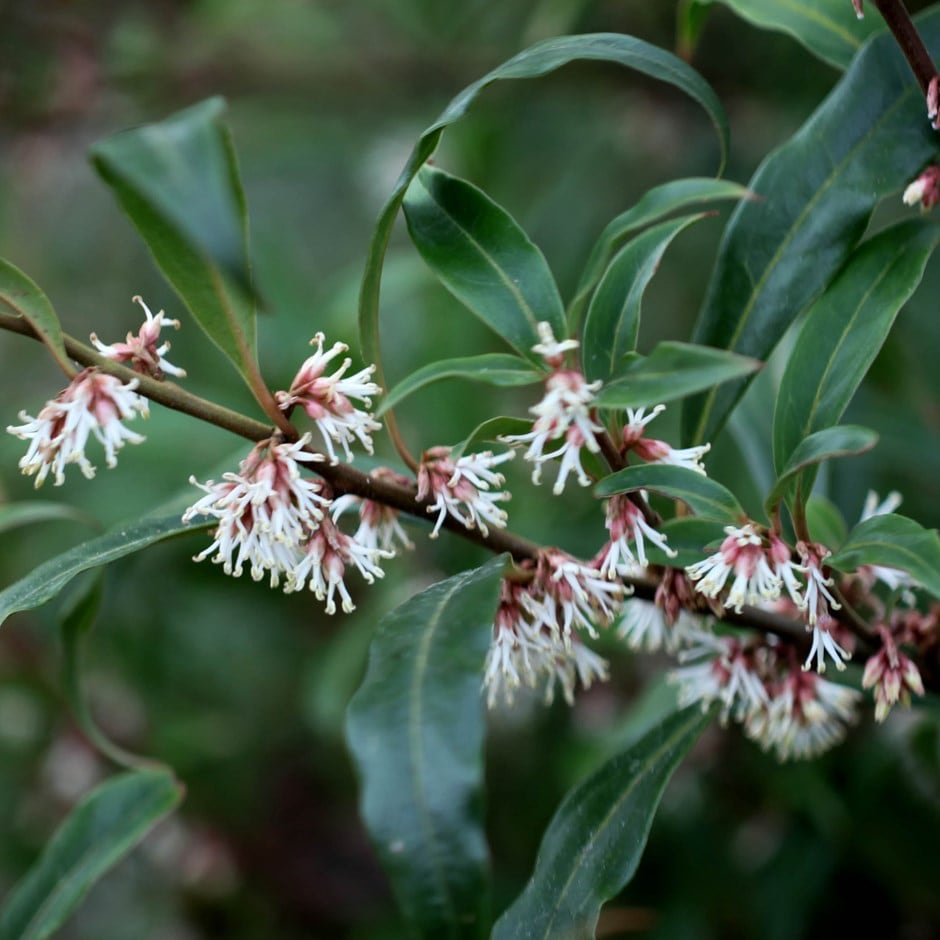
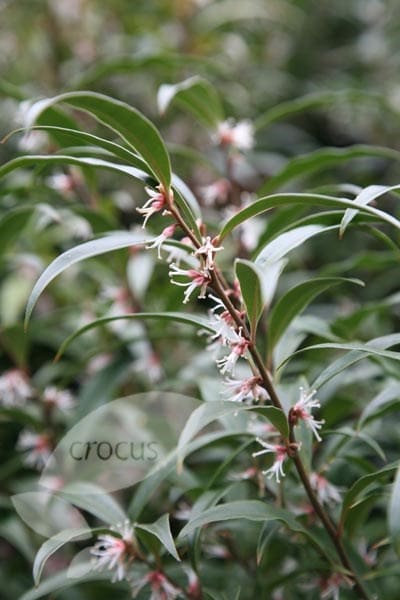
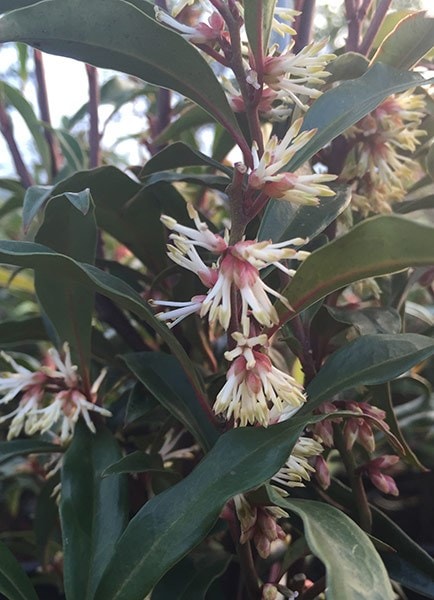
Sarcococca hookeriana var. digyna
sweet box
- Position: partial to deep shade
- Soil: moderately fertile, humus-rich, moist, well- drained soil
- Rate of growth: slow-growing to average
- Flowering period: December to March
- Flower colour: creamy-white
- Other features: the flowers are followed by spherical, black or blue-black berries
- Hardiness: fully hardy
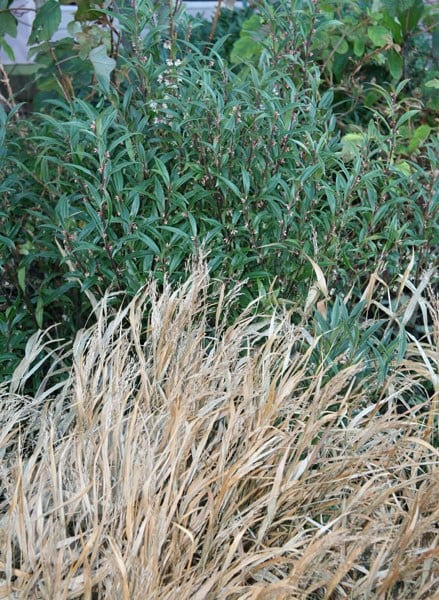
Clusters of small, creamy-white, tassel-like flowers and slender, mid- to dark green leaves. This compact, thicket-forming shrub is perfect for planting below a window, close to an entrance or path. Excellent evergreen groundcover for a moist, shady spot, the unassuming flowers are deceptive - their vanilla-like scent is one of the headiest winter fragrances. - Garden care: In late-winter or early-spring lightly trim or prune back shoots that spoil the plant's symmetry. After pruning apply a generous 5-7cm (2-3in) mulch of well-rotted compost around the base of the plant.
9cm pot
within 2-3 days excludes weekends
2lt pot (60cm cane)
within 2-3 days excludes weekends
2 litre pot
within 2 weeks
Do you want to ask a question about this?
If so, click on the button and fill in the box below. We will post the question on the website, together with your alias (bunnykins, digger1, plantdotty etc etc) and where you are from (Sunningdale/Glasgow etc). We'll also post the answer to your question!12 Questions | 12 Answers
Displaying questions 1-10Previous | Next »
Q:
Help with plants for N/East facing garden
Hi, I have a little problem choosing some plants....... I really like the look and size of the 'Shady Pink' pre-designed corner planting plan, but our problem is that we have a north east facing garden, so we get no sun at all in the winter, and direct sun for only half a day on either side of the garden during the summer. Would this planting plan be suitable for that level of shade? We are actually are buying plants for the entire garden, so we'd need about 6 new shrubs, and maybe a small tree (we were thinking about the Prunus Amanogawa). Could you please help us with a few shrubs that would do well in these conditions? For perennials, we have been recommended; - Geranium Johnson's Blue, Kniphofia, Crocosmia, and Helleborus foetidus. Are these suitable? Many many thanks! Regards, JoseeAsked on 4/12/2010 by Josee Mallet1 answer
A:
Hello Josee, It is always difficult to give a definitive answer to the shade issue, but looking at the Shady Pink border, the most shade tolerant plants include Anemone hupehensis Hadspen Abundance, Thalictrum aquilegiifolium and Dryopteris erythrosora. If you click on the following link it will take you to all our shade-loving shrubs http://www.crocus.co.uk/plants/_/shrubs/plcid.1/vid.11/ and for the shade -loving perennials http://www.crocus.co.uk/plants/_/perennials/plcid.2/vid.11/ Of the plants you have listed, the Prunus, Helleborus foetidus, Kniphofia and Crocosmia will be OK as long as there is more sun than shade. I hope this helps. Helen Plant DoctorAnswered on 4/13/2010 by Crocus Helpdesk
Q:
Plants for an difficult area
HELP, please...... I have moved into one of those places where the front garden is just paving blocks (I do need to use it as I have no garage). I have managed to put in a curved triangular bed which is about 5 foot either side - I could increase this by another foot if it helps. The site is extremely windy, catches the frosts and only gets the sun in the late afternoon. Also rain runs down into this area. I am looking for ideas on what to plant......should I go for several small plants, or one specimen plant? Nothing can get taller than around 3 - 4 foot. I also plan to put some spring bulbs in, but I don't want to give myself too much work as I am a pensioner and on my own, and already have a reasonable sized back garden to cope with. Is this impossible or can you help me? Many thanks SueAsked on 3/18/2010 by Susan Chipchase1 answer
A:
Hello Sue, This does sound like a pretty inhospitable situation, so you will need some tough plants - here are your best options. Cotoneaster horiontalis http://www.crocus.co.uk/plants/_/shrubs/cotoneaster-horizontalis-/classid.1028/ Cotoneaster dammeri http://www.crocus.co.uk/plants/_/shrubs/cotoneaster-dammeri-/classid.1021/ Sarcococca confusa http://www.crocus.co.uk/search/_/search.sarcococca/ Viburnum davidii http://www.crocus.co.uk/plants/_/shrubs/viburnum-davidii-/classid.8067/ Aucuba (which can be cut back hard when necessary) http://www.crocus.co.uk/search/_/search.aucuba/ Skimmia http://www.crocus.co.uk/search/_/search.skimmia/ I hope this gives you a few ideas. Helen Plant DoctorAnswered on 3/18/2010 by Crocus Helpdesk
Q:
Sarcococca confusa-is it scented?
Hi, Last spring I purchased a Sarcococca confusa as a gift for a friend after hearing on the radio about it's lovely perfume when it flowered in the winter, and that ideally it should be planted near the door to the house to best benefit the scent. Although my friend has told me her plant has been covered in flowers and looks really healthy there is no perfume at all which is quite disappointing. Have we just been unlucky or is there a specific variety I should have chosen as I intend to buy more of these plants. I would be very grateful if you could give me some advice on this. Many thanks JuneAsked on 1/20/2010 by Iain Yule1 answer
A:
Hello There, The most commonly available Sarcococca is S, confusa and this has highly scented flowers. The S. hookeriana flowers are still quite scented, but not quite as strong. If she has one of these then I am mystified as to why hers does not give off a beautiful scent if it is in flower. I'm sorry not to be more help. Helen Plant DoctorAnswered on 1/20/2010 by Crocus Helpdesk
Q:
Winter flowering shrubs and climbers to plant with new hedge
Hello, I have newly planted a hedge (made up from Hornbeam, Rosa rugosa, Blackthorn, Cornus, Hawthorn and Hazel) about 50ft long. I have been told that if I was to plant amongst the hedge some winter flowering Clematis such as 'Wisley Cream' it would give some nice colour these bleak winter months when the hedge is bare of foliage. The hedge is south facing and although the ground is ???good??? heavy Cambridgeshire clay the hedge has been planted in a trench back filled with leaf mulch, chipped wood and spent peat. Although I have said about in-planting Clematis in the hedge, I am open to other plant suggestions if you have any. Regards TerryAsked on 12/31/2009 by Terry Allum1 answer
A:
Hello Terry, If you click on the following link it will take you to all our winter flowering climbers - of which the Jasminum is tougher and more like a shrub. http://www.crocus.co.uk/plants/_/climbers/plcid.15/vid.204/ Alternatively, this link will take you to all our winter flowering shrubs. http://www.crocus.co.uk/plants/_/shrubs/plcid.1/vid.204/ I hope this helps. Helen Plant DoctorAnswered on 1/5/2010 by Crocus Helpdesk
Q:
Low maintenance exterior plants for office lightwell
Hello Plant Doctor, Please advise on which evergreen plants would be suitable for a shady lightwell in my new office. Many Thanks, ColinAsked on 10/7/2009 by COLIN WATSON1 answer
A:
Hello Colin, If you click on the following link it will take you to a selection of evergreen shrubs that can tolerate low light levels. http://www.crocus.co.uk/plants/_/shrubs/plcid.1/vid.11/vid.228/ I hope this gives you a few ideas. Helen Plant DoctorAnswered on 10/9/2009 by Crocus Helpdesk
Q:
Plants for outside my front door
Hi Crocus I live in a flat and have pots outside my external front door. What plants can I grow in pots, in semi shade that will attract the bees? Thank you for your help. Kind regards GuyAsked on 7/29/2009 by Guy Smith1 answer
A:
Hello Guy, The following plants would be suitable for your pots. Forget-me-not (Myosotis species) Bellflowers (Campanula species) Cranesbill (Geranium species) Dahlia - single-flowered species and cultivars Hellebores (Helleborus species) Japanese anemone (Anemone ?? hybrida) Fritillaries (Fritillaria species) Grape hyacinth (Muscari species) Hyacinth (Hyacinthus orientalis) Siberian squill (Scilla siberica) Winter aconite (Eranthis hyemalis) Box (Buxus sempervirens) Christmas box (Sarcococca species) I hope this helps, Helen Plant DoctorAnswered on 7/30/2009 by Crocus Helpdesk
Q:
Plants suitable for patio pots
Hello I wanted to enquire if you have a Sarocococca hookeriana var. humilis, I looked online but it's not listed. I am askng for that particular plant, because I only have a patio and want plants that won't grow to an enormous size or require spectacular care. A rosemary and a dwarf syringa I bought from you are doing very well. Plants always arrive in very good condition which I really appreciate. A Myrtus communis subsp. 'Tarentina' which I potted up immediately in a larger pot suffered shock I think, - I wonder what you know about this myrtle? I am wanting to grow plants on a small patio in containers and wonder if the following plants are suitable:- Sarcococca hookeriana var. humilis (if you have got it) or a Sarcococca hookeriana digyna (which is in your listings). Winter Jasmine, or any of the other Jasmines, Wintersweet, Witchhazel, Abelia grandiflora but would this be too large for my patio- I am thinking of winter cheer with its red berries, and Nandina Domestica. Many thanks BernadetteAsked on 7/26/2009 by Bernadette Matthews1 answer
A:
Hello Bernadette, I'm afraid we do not sell Sacrocococca hookeriana var. humilis, but the other two we list will be fine in a large pot as long as they are kept well fed and watered. It is my experience that most plants will cope if the pot is big enough and they are well looked after, however larger plants like the Jasminum nudiflorum, Wintersweet, Witchhazel, Abelia or Nandinas will eventually run out of steam and need to be placed into the garden. You should however be able to get a good few years from them. As for the Myrtus, I have not heard that they particularly dislike being moved, but as they are not fully hardy they need protection in winter. I hope this helps. Helen Plant DoctorAnswered on 7/27/2009 by Crocus Helpdesk
Q:
Difficult corner...
Hi We have a problem area in our front garden. It is a triangular bed with two sides bounded by low walls, which form part of the boundaries to our property. The soil is more alkaline than acid, and has been described as silt, with quite a lot of flinty pebbles. Most of the front garden is lawn, with one rectangular bed below our kitchen window. Unfortunately for us the whole corner area is overshadowed from the south by our next door neighbour's tree. This is a walnut, which during the summer months cuts off most of the sunlight from the bed and which also throws a rain shadow over it. The tree is protected by a preservation order but it has had the crown lifted and thinned. It is now filling in downwards with flowers, leaves, nuts etc all falling into the triangular bed at regular intervals. It seems to dislike any neighbouring trees - we lost a rather lovely white-flowering prunus from our front lawn two years ago, the crown of which grew just high enough to touch a branch of the walnut. I have read that walnuts exude a toxic substance, to keep rivals at bay! We have one Camellia japonica (about 2.5 metres high) and one Fuchsia magellanica which apparently are reasonably happy in their situation ina corner. We planted a small Pittosporum tenuifolium (which is surviving but not at all happy) and two Ceanothus thyrsiflorus var. repens, both of which have died. We also planted six Vinca minor, three of which failed to survive. (The survivors have been moved to another bed). Are there any evergreen shrubs or perennials that might survive in this bed? We do want something that will at least partially block the view of a small block of flats on the opposite side of the road, but are finding it difficult to work out a solution to our present problem. So could you please suggest something that we could successfully plant, other than laurels or aucuba, both of which my wife dislikes. Kind regards MichaelAsked on 7/19/2009 by Anonymous1 answer
A:
Hello There, This is a very difficult situation for plants as there will be very little moisture and nutrients in the soil. The best plants will be the toughest, however even these will need to be kept really well fed and watered if they are to survive. Here are your best options Viburnum tinus http://www.crocus.co.uk/search/_/search.tinus/ Sarcococca http://www.crocus.co.uk/search/_/search.sarcococca/ Ilex http://www.crocus.co.uk/plants/_/shrubs/hedging/ilex-%C3%97--altaclerensis-golden-king/classid.4029/ Mahonia http://www.crocus.co.uk/plants/_/shrubs/mahonia-%C3%97-media-charity/classid.4158/ Euonymus fortunei varieties http://www.crocus.co.uk/findplant/results/?CommonName=euonymus+for Alchemilla mollis http://www.crocus.co.uk/findplant/results/?ContentType=Plant_Card&ClassID=233&CategoryID= Pachysandra terminalis http://www.crocus.co.uk/findplant/results/?ContentType=Plant_Card&ClassID=3288&CategoryID= Bergenias http://www.crocus.co.uk/findplant/results/?CommonName=bergenia Iris foetidissima http://www.crocus.co.uk/findplant/results/?ContentType=Plant_Card&ClassID=3073&CategoryID= Lamiums http://www.crocus.co.uk/findplant/results/?CommonName=lamium Liriope muscari http://www.crocus.co.uk/findplant/results/?ContentType=Plant_Card&ClassID=3173&CategoryID= Cotoneaster dammeri http://www.crocus.co.uk/findplant/results/?ContentType=Plant_Card&ClassID=1021&CategoryID= I hope this gives you a few ideas. Helen Plant DoctorAnswered on 7/20/2009 by Crocus Helpdesk
Q:
Shrub orsmall bush for a dark lightwell?
Hello We have recently dug out a basement which now leaves us with two lightwells - a big one at the front of the house in which two tree ferns are flourishing and another smaller, darker lightwell at the back of the basement in which a black bamboo is in the slow process of dying. Any ideas for this one? The area is about four foot square and about 10 feet below ground level. It and gets no direct sunshine. Many thanks, JackieAsked on 7/11/2009 by Jackie Offenbach1 answer
A:
Hello Jackie, A reasonable amount of light is one of the basic requirements for a happy and healthy plant, so it sounds as if you may have a struggle on your hands. The following shrubs are some of the best for growing in low light levels, so perhaps one of these might survive. Aucuba http://www.crocus.co.uk/search/_/search.aucuba/ Skimmia http://www.crocus.co.uk/search/_/search.skimmia/ Sarcococca http://www.crocus.co.uk/search/_/search.sarcococca/Answered on 7/13/2009 by Crocus Helpdesk
Q:
What plants for a neglected patch?
Hello, We are trying to improve a rather nasty mud patch in our garden. It is in the shade and the soil is very, very dry - we have had to use a pick axe to turn it over. My question is what types of plants would be suitable for this terrain? Kind Regards, MarkAsked on 6/24/2009 by Mark Siddle1 answer
A:
Hello Mark, All plants will need a degree of comfort, so the best thing to do would be to improve the soil by digging in as much organic matter as you can. Once you have done this you can plant tough, low maintenance things like Ajuga, Alchemilla mollia, Aucuba japonica, Berberis, Bergenia, Euonymus fortunei, Lamium, Sarcococca, Skimmia, Viburnum davidii or Vincas. It will be very important though that these are kept really well watered for at least the first year until they have had a chance to become established. I hope this helps. Helen Plant DoctorAnswered on 6/26/2009 by Crocus Helpdesk
Displaying questions 1-10Previous | Next »
Woodland
A sanctuary of peace and tranquillity with an overwhelming sense of calm, a woodland garden is an ideal place to get away from it all with natural shade and privacy. Based on...
Read full articleHoney fungus
Symptoms There are different symptoms which point to honey fungus, some or all of them may be present at one time. Also, death can take years or be virtually instantaneous with plants being suddenly stopped in their tracks, half-opened leaves just...
Read full article


The most lily-scented of all the sarcococcas with red-pink clusters of stamens held against yellow-green leaves
Val Bourne - Garden Writer