
Buxus sempervirens
common box
- Position: partial shade
- Soil: fertile, well-drained soil, including chalky
- Rate of growth: slow-growing
- Hardiness: fully hardy
To find out more about how to plant a hedge, click here
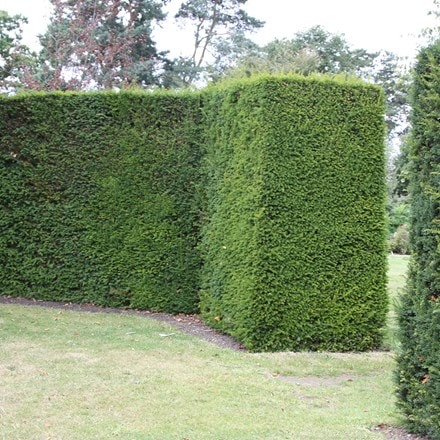
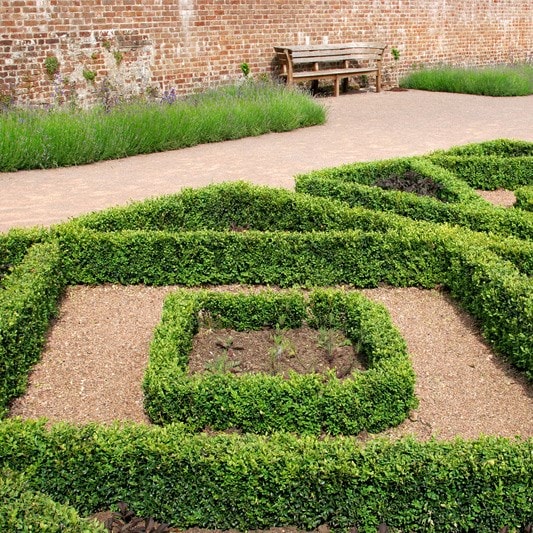
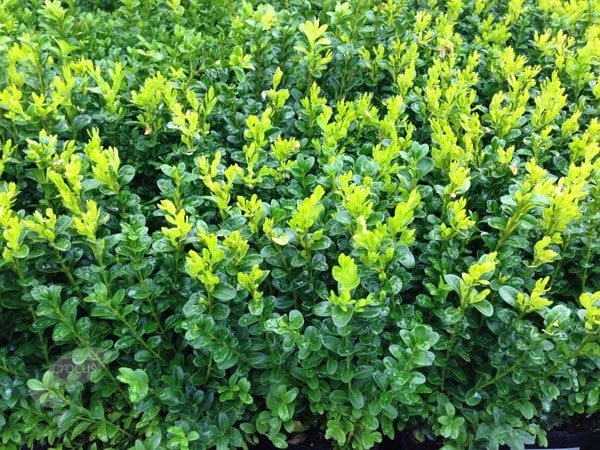
Common box makes a fabulous formal hedge for a partially shady site, forming a dense, evergreen screen of small, rounded, lustrous, dark green leaves. One of our recommended plants, it's an excellent backdrop for traditional herbaceous borders.
Box is happy growing in a sunny spot but the combination of dry soil and full sun may encourage poor growth and leaf scorching. If you have sandy soil, it is best to keep it in a partially shady spot in the garden. - Garden care: For maximum results plant 30cm (12in) apart in well-prepared, fertile soil and water regularly until well established. Ensure that the soil or compost is never allowed to dry out. Carefully trim plants grown as hedges or topiary in mid- or late summer. Carry out rejuvenative pruning in late spring. After pruning apply a top-dressing of a balanced slow-release fertiliser such as blood, fish and bone (organic) or Osmocote (inorganic) around the base of the plant, ensuring that none touches the leaves or stems.
Do you want to ask a question about this?
If so, click on the button and fill in the box below. We will post the question on the website, together with your alias (bunnykins, digger1, plantdotty etc etc) and where you are from (Sunningdale/Glasgow etc). We'll also post the answer to your question!Q:
Hi,
We planted a box hedge about a year and a half ago in a circular shape in a raised bed with stone wall. They were fine for about a year, but slowly all the leaves are becoming tipped with yellow, and a couple of the plants have turned bronze. Is there anything we can do to salvage this?Asked on 2/1/2013 by Lily1 from South London1 answer
A:
Hello,
There are a number of things that can cause the symptoms you describe, but the most likely cause is stress brought on by summer drought or winter wet. These symptoms however can also be attributed to a nutrient deficiency, so make sure the plants are kept well fed with a good, general purpose fertiliser such as Vitax Q4, and keep and eye on the watering.
I hope this helps,Answered on 2/4/2013 by Helen from Crocus
Q:
Buxus hedging plants
Hello Can you advise please? I'm looking for 20 young Box bushes, i.e. approx. 40cms in height, to fill the gaps in a knot garden. I've checked the website and notice you have Box but they seem to be large cone shaped or very small, (in 9cm pots). Do you stock these? Look forward to hearing from you, Thank you, JulieAsked on 4/11/2010 by Anonymous1 answer
A:
Hello Julie, We only sell Buxus in 9cm or 1.5lt pots now, which are approx 10-15cm or 15-20cm. Sorry we can't be more help. Helen Plant DoctorAnswered on 4/12/2010 by Crocus Helpdesk
Q:
Buxus problem
I bought some Buxus from you last year,- 2 are still healthy but one, which was in a tub next to the other 2, so in the same situation, has gone yellow and appears to be dying. What might have caused this please, and is there any way of resurrecting the plant? Many thanks for your help, HilaryAsked on 12/3/2009 by H Corroon1 answer
A:
Hello Hilary, As it is growing in a pot, the most likely problems are either too much or too little watering. I would check to make sure that the drainage hole in the bottom of the pot is not blocked or that when you do water it, it doesn't just run around the sides of the rootball. The other thing to look out for is box blight, but this is usually accompanied by a fungal growth. I hope this helps. Helen Plant DoctorAnswered on 12/3/2009 by Crocus Helpdesk
Q:
Hedging and Osmanthus plants
Dear Crocus, I am looking for two Osmanthus burkwoodii plants but notice on your website that you only offer them for sale in 2 litre size. Do you have any larger Osmanthus burkwoodii plants? I am also looking for suggestions on which plants would make a good hedge. I am looking for something hardy, able to stand the frost, evergreen, not poisonous to horses and if possible, not just green possibly red / purple or variegated, any thoughts? Also, as these plants are grown in Surrey, will they be suitable to grow in the Scottish Borders? Many thanks, JaneAsked on 11/29/2009 by Janey Mitch1 answer
A:
Hello Jane, I'm afraid we have all the plants we sell displayed on our website so we do not sell larger sizes of the Osmanthus. As for the hedging, if you click on the link below it will take you to our full range of hedging plants. Unfortunately we do not have anything that meets all your criteria, but if you click on the smaller images it will give you a lot more information on hardiness levels (fully hardy means they can cope with the weather in Scotland) as well as leaf colour etc. Unfortunately though I do not have a list of plants which are not poisonous to horses, but your local vet may be able to help you with this. http://www.crocus.co.uk/plants/_/hedging/plcid.30/ Best regards, Helen Plant DoctorAnswered on 11/30/2009 by Crocus Helpdesk
Q:
Box blight
Hi, I have recently had to dig up all my box hedges (one had been growing for about 20 years!) because of box blight. My love affair with the plant has well and truly ended! My garden now looks so bare. Can you give me any ideas for more reliable plants to replace them with (not necessarily hedging). MargaretAsked on 10/10/2009 by Margaret Hamilton1 answer
A:
Hello Margaret, Box Blight has become a nuisance in the last few years, and I can only imaging how annoying and upsetting it must have been to have to dig all your plants up. I would still consider box to be a reliable plant though, especially as most plants are prone to some annoying and potentially dangerous pests or diseases. Therefore I am not really sure what to suggest, but if you click on the following link however it will take you to our full range of shrubs, which we consider 'low maintenance'. http://www.crocus.co.uk/plants/_/shrubs/plcid.1/vid.176/ I'm sorry not to be more help. Helen Plant DoctorAnswered on 10/12/2009 by Crocus Helpdesk
Q:
Plants for outside my front door
Hi Crocus I live in a flat and have pots outside my external front door. What plants can I grow in pots, in semi shade that will attract the bees? Thank you for your help. Kind regards GuyAsked on 7/29/2009 by Guy Smith1 answer
A:
Hello Guy, The following plants would be suitable for your pots. Forget-me-not (Myosotis species) Bellflowers (Campanula species) Cranesbill (Geranium species) Dahlia - single-flowered species and cultivars Hellebores (Helleborus species) Japanese anemone (Anemone ?? hybrida) Fritillaries (Fritillaria species) Grape hyacinth (Muscari species) Hyacinth (Hyacinthus orientalis) Siberian squill (Scilla siberica) Winter aconite (Eranthis hyemalis) Box (Buxus sempervirens) Christmas box (Sarcococca species) I hope this helps, Helen Plant DoctorAnswered on 7/30/2009 by Crocus Helpdesk
Q:
What is that plants name?
Hi, Could you please help me to find a product of which I actually do not know its name but it is that plant that many people keep on their windows and it is like a small bush with the shape of a sphere. Thanks! BenedettaAsked on 6/30/2009 by Arnoldi Benedetta1 answer
A:
Hello Benedetta, I wonder if you mean Buxus sempervirens, which can be trained as topiary into all sorts of shapes - including balls.Answered on 7/4/2009 by Crocus Helpdesk
Q:
Help shaping box plants
Can you advise if you sell anything to help shape box edges. I remember seeing wire frames somewhere that can be used.Asked on 8/1/2007 by Matthew Lewis1 answer
A:
We do sell a wire frame that can be used to help shape topiary - just click on the following link to go straight to it. http://www.crocus.co.uk/product/_/quick-hen-topiary-maker/classid.2000005040/Answered on 8/1/2007 by Crocus
Q:
What tough plants can I grow in big pots?
I am looking for plants to fill up some outdoor planters facing a carpark. I want something tough please - can you give me 2 to 3 options?Asked on 2/6/2006 by Fung1 answer
A:
There are several plants that will be suitable for growing in your containers. Below I have listed plants that are quite low maintenance and tough - just on the links below to access my suggestions:- Elaeagnus http://www.crocus.co.uk/search/_/search.elaeagnus/?s=elaeagnus Aucuba http://www.crocus.co.uk/search/_/search.aucuba/?s=aucuba Euonymus http://www.crocus.co.uk/plants/_/shrubs/euonymus-fortunei-emerald-gaiety/classid.3820/ Fatsia japonica http://www.crocus.co.uk/plants/_/shrubs/fatsia-japonica-/classid.3840/ Buxus http://www.crocus.co.uk/search/_/search.buxus/?s=buxus Skimmia http://www.crocus.co.uk/search/_/search.skimmia/?s=skimmiaAnswered on 2/8/2006 by Crocus
Q:
Which plants are Deer proof?
I want a list of Deer proof plants please. It`s either a change in habitat or environment, but I get total devastation now and in the last two years they come up the drive.Asked on 2/3/2006 by david1 answer
A:
Deer can be a real problem and deer proof plants are usually thorny, poisonous or simply taste awful, but it is hard to give a definitive list as you might get the odd deer with unusual tastes which might like the bitter taste! Below is a list of good plants that generally are quite successful though. Cornus varieties, Rhus, Sophora, Solanum, Berberis, Rosemary, Buxus, Cotoneaster, Ilex, Pyracantha, Garrya, Juniperus, Nandina, Elaeagnus, Aralia, Aucuba, Cortaderia, Yucca, Santolina, Hypericum, Myrtle, Vinca, Achillea, Digitalis, Echinacea and Dryopteris. Finally, fencing is one method to protect garden crops from deer. Since deer jump, you need an 8-foot fence for best results or stout chicken-wire fencing securely around smaller garden plots. Alternatively, fence the area with a thorny shrub, preferably something that will grow to at least 6 feet. Deer eat roses and some thorns but hawthorn, boxwood and holly will exclude them. Deer are also deterred by dogs, hanging aluminum foil, mirrors, wood that hits objects in the wind and other noise-makers. Some old-fashioned repellents are human hair and blood and bonemeal. Hanging bars of fragrant deodorant soap from branches may work. Other well-known deer repellents are mothballs or moth flakes spread on the ground or put in mesh bags for hanging in a tree. Unfortunately though, no repellent is 100 percent effective, especially if the deer population is high and deer are starving.Answered on 2/6/2006 by Crocus
How to create a wildlife-friendly garden

An organic garden should also be a wildlife-friendly garden. Not only is it wonderful to see nature at work, but many creatures will help you achieve better results. The ponds in my garden act as a magnet to dragonflies and...
Read full articleJuly pruning of trees, shrubs and climbers
Early-summer- flowering shrubs can be pruned this month to keep them vigorous and flowering well. It is also the ideal time to prune several trees that are prone to bleeding if pruned at other times, and it’s not too late...
Read full articleFormal
This new 'How to' garden section will build-up into a comprehensive practical guide to all aspects of growing and looking after your garden. I'll outline the basics step-by-step as well as highlight effective shortcuts that the professionals use. I'll also...
Read full articleTown
Create an ‘outside room’ that overcomes the three challenges of shade, exposure and lack of space using uplifting, shade-tolerant shrubs, perennials and bulbs. A sense of seclusion can be achieved with decorative screens and trellis covered in deciduous, fragrant...
Read full articleJapanese
Make the most of over 3000 years of gardening tradition by creating an oriental-style garden. Originally designed as a place for intellectual contemplation and meditation, they are an ideal sanctuary from...
Read full articleHoney fungus
Symptoms There are different symptoms which point to honey fungus, some or all of them may be present at one time. Also, death can take years or be virtually instantaneous with plants being suddenly stopped in their tracks, half-opened leaves just...
Read full articlePlanting a hedge
Hedges by their very nature are often planted in exposed positions, so the secret of successful establishment is to make sure that they are well protected from prevailing winds for the first few years. Careful planting and covering the surface...
Read full article


Slow-growing box for topiary and hedges and the best small, wintergreen structure plant of all - and only a once-a-year June trim!
Val Bourne - Garden Writer