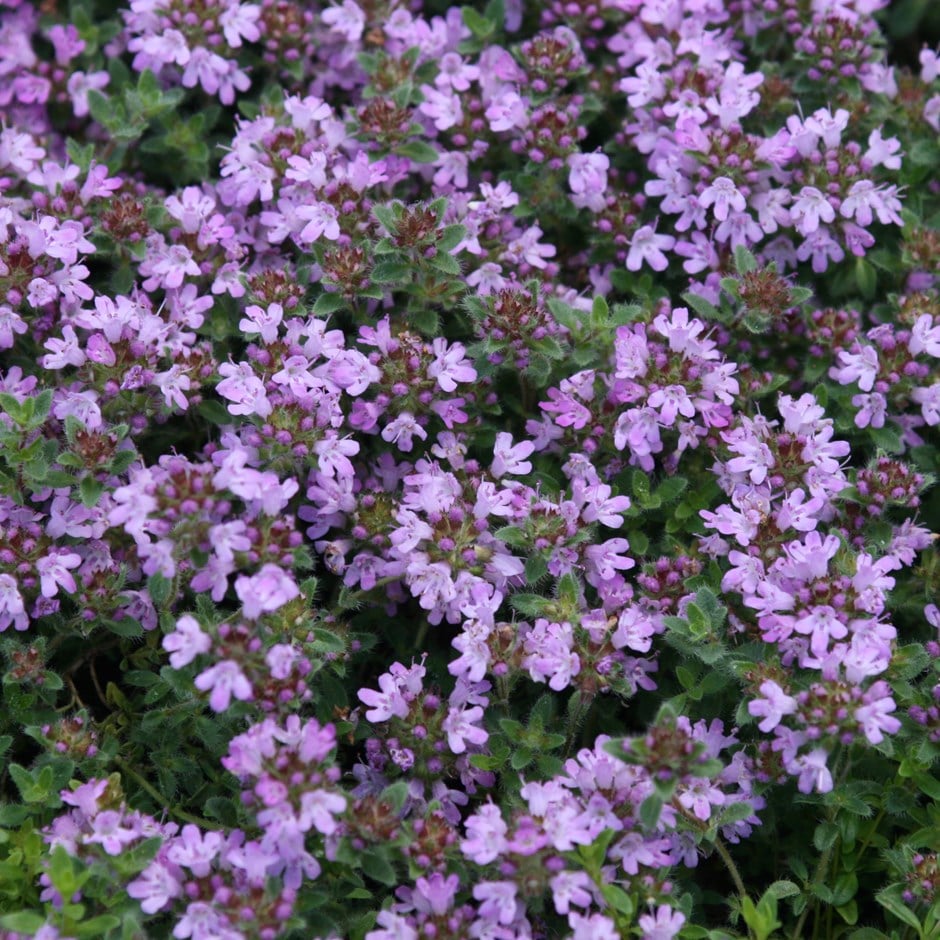


Thymus pseudolanuginosus
woolly thyme
- Position: full sun
- Soil: well-drained neutral to alkaline soil
- Rate of growth: average to fast
- Flowering period: June to July
- Flower colour: pale pink
- Other features: extremely low growing
- Hardiness: fully hardy
Tiny, pale pink flowers appear in summer amongst small, grey, woolly foliage. This is one of the woolliest thymes available and as its low growing is ideal as an unusual ground cover. Unfortunately it's not suitable for culinary use but the flowers are highly attractive to bees and other beneficial pollinating insects. Great for growing between paving or in cracks in stone walls. - Garden care: Susceptible to root rot in poorly drained soils. If necessary, lightly trim to remove dead flowers, and cut back harder after flowering to keep them compact and bushy.
Do you want to ask a question about this?
If so, click on the button and fill in the box below. We will post the question on the website, together with your alias (bunnykins, digger1, plantdotty etc etc) and where you are from (Sunningdale/Glasgow etc). We'll also post the answer to your question!Q:
Thymus pseudolanuginosus looking woody
Hi I have three of these Thymus and I now notice that two of the plants look to be dying in the centre. The soil is fairly well draining and loose, and was well fertilised with manure two years ago. Any thoughts please? BillAsked on 7/7/2009 by BILL HEADLEY1 answer
A:
Hello Bill, To keep these plants looking bushy and to encourage more growth forming in the centre, it is advisable to cut them back quite hard in late summer.Answered on 7/9/2009 by Crocus Helpdesk
Q:
What low-growing evergreen would you suggest?
Please help! Can you suggest a very low growing plant to cover a 1 metre long area alongside a lawn. It needs to be able to cope with fairly dry sunny conditions and be attractive all the time so nice leaves or similar.Asked on 6/30/2006 by Lesley Levy1 answer
A:
We do have some plants that may be suitable for the area you have described. Below are a few of my suggestions, but you can find many more on our site using our plant search facility. Ajuga http://www.crocus.co.uk/search/results/?q=ajuga Festuca glauca Elijah Blue http://www.crocus.co.uk/findplant/selectionresults/?ContentType=Plant_Card&ClassID=1993&CategoryID= Calluna vulgaris Dark Star http://www.crocus.co.uk/plants/_/heathers/calluna-vulgaris-dark-star/classid.464/ Stachys byzantina Silver Carpet http://www.crocus.co.uk/plants/_/perennials/mediterranean-plants/stachys-byzantina-silver-carpet/classid.3621/ Thymus pseudolanuginosus http://www.crocus.co.uk/plants/_/herbs/prices-that-have-been-pruned/thymus-pseudolanuginosus-/classid.2000007112/ Bergenia http://www.crocus.co.uk/search/_/search.bergenia/?s=bergeniaAnswered on 7/3/2006 by Crocus
Q:
What trailing plants would you suggest?
I have just had my sloping garden landscaped and now have a great many retaining walls which need softening with planting. Some walls have paths below them so I cannot plant climbing plants. Could you please suggest some plants which would trail down from a higher planting position?Asked on 11/24/2004 by Clive Zietman1 answer
A:
Below is a list of plants that should grow well on a sunny slope. Before planting dig in loads of composted farmyard manure to help increase the water holding capacity of the soil. Back breaking work but worth it in the long run.SHRUBS 'Cotoneaster dammeri' http://www.crocus.co.uk/findplant/results/?ContentType=Plant_Card&ClassID=1021&CategoryID= 'Hebe pinguifolia Pagei' http://www.crocus.co.uk/findplant/results/?ContentType=Plant_Card&ClassID=3935&CategoryID= 'Rosa Pink Flower Carpet' http://www.crocus.co.uk/findplant/results/?ContentType=Plant_Card&ClassID=2325&CategoryID= 'Ceanothus thyrsiflorus var. repens' http://www.crocus.co.uk/plants/_/shrubs/ceanothus-thyrsiflorus-var.-repens/classid.727/ PERENNIALS 'Alchemilla mollis' http://www.crocus.co.uk/findplant/results/?ContentType=Plant_Card&ClassID=233&CategoryID= Ajuga http://www.crocus.co.uk/search/_/search.ajuga/?s=ajuga 'Geranium macrorrhizum White Ness' http://www.crocus.co.uk/plants/_/geranium-macrorrhizum-white-ness/classid.2000015973/ 'Origanum vulgare Aureum' http://www.crocus.co.uk/findplant/results/?ContentType=Plant_Card&ClassID=3282&CategoryID= 'Thymus pseudolanuginosus' http://www.crocus.co.uk/plants/_/herbs/prices-that-have-been-pruned/thymus-pseudolanuginosus-/classid.2000007112/ Vincahttp://www.crocus.co.uk/search/_/search.vinca/?s=vincaAnswered on 11/25/2004 by Crocus
How to encourage beneficial insects

All pests have natural enemies. The trick in an organic garden is to encourage these beneficial insects and other creatures to take up residence in your garden so that they can do the pest management for you. The most effective...
Read full articleHow to use companion plants
Companion planting is a method of growing different plants adjacent to one another for the benefit of one or both of the companions. Some plants are thought to confuse or act as a decoy to potential pests, while a few...
Read full articleAugust pruning of trees, shrubs and climbers
Late summer is the best time to prune many midsummer-flowering shrubs to keep them vigorous and flowering well. It is also the ideal time to prune several trees that are prone to bleeding if pruned at other times, and it’s...
Read full articleHow to win the war on weeds

If you let weeds gain a foothold, you’ll have trouble for months and even years to come, but to gain control and win the war against weeds you will need to get to know your enemy. The commonest weeds in...
Read full article