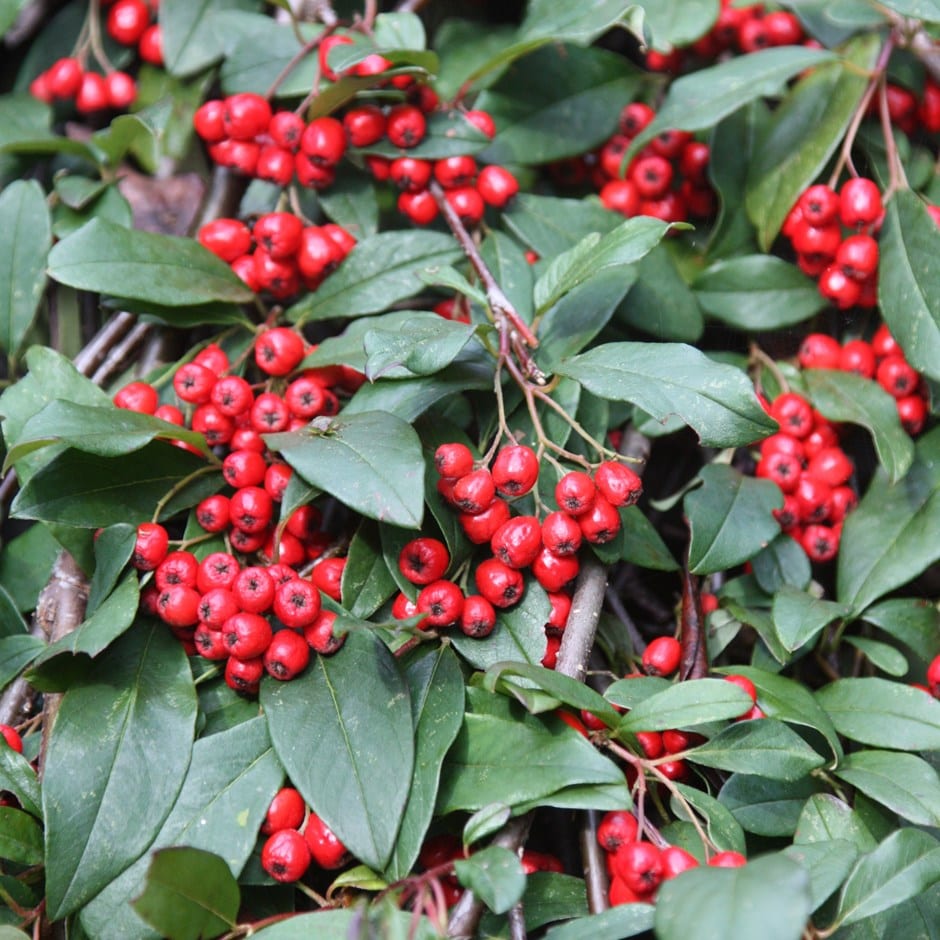
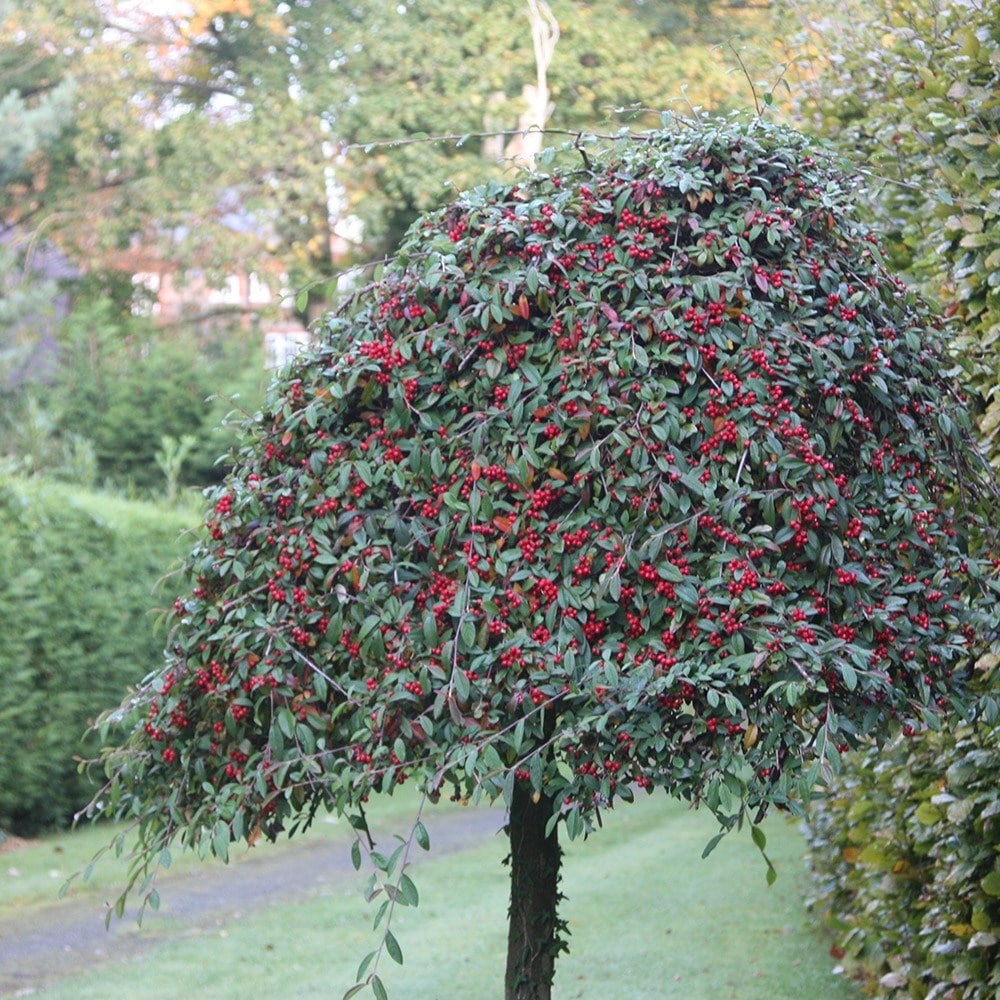
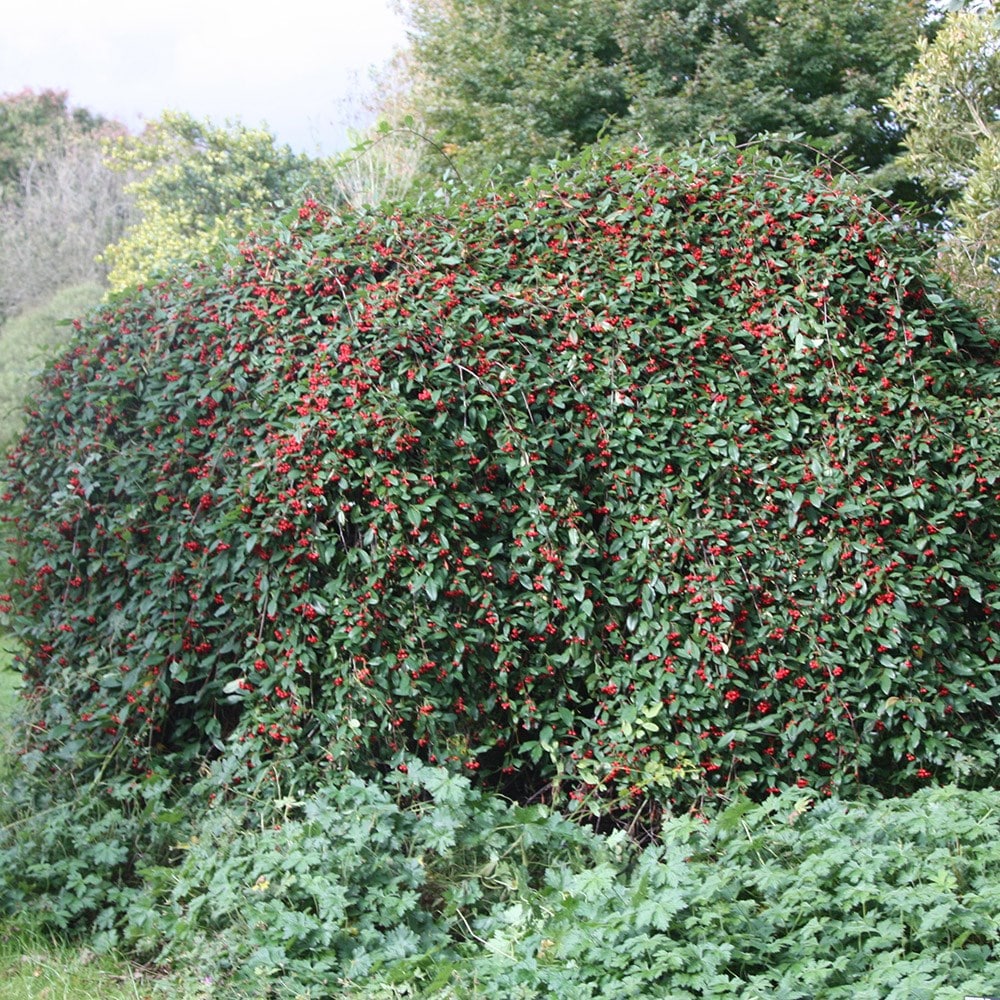
Cotoneaster 'Hybridus Pendulus'
standard cotoneaster
- Position: full sun or partial shade
- Soil: moderately fertile, well-drained soil
- Rate of growth: average
- Flowering period: June
- Flower colour: white
- Other features: the seeds of the fruit may cause mild stomach upset if ingested
- Hardiness: fully hardy
Pretty, small white flowers in June followed by showy, bright red, autumn berries. This upright evergreen or semi-evergreen shrub forms a lovely tree with weeping branches when grown as a standard. Like most Cotoneasters, it can tolerant a wide range of conditions including dry soil. - Garden care: In late spring or early summer after flowering lightly cut back any branches that spoil the symmetry of the plant and apply a generous 5-7cm (2-3in) mulch of well-rotted garden compost or manure around the base of the plant. In autumn trim back lightly any branches that obscure the display of fruit.
Do you want to ask a question about this?
If so, click on the button and fill in the box below. We will post the question on the website, together with your alias (bunnykins, digger1, plantdotty etc etc) and where you are from (Sunningdale/Glasgow etc). We'll also post the answer to your question!Q:
Specimen plant/tree for centre of lawn
Hello, I'm planning on having a specimen plant/tree to go into the centre of the lawn in our garden, but I'm unsure of what the best choice would be. The area isn't very large so ideally I'm looking for something that will not grow very big, no more than 5 feet in height would be ideal. I really like Cherry trees and Magnolias, but I'm unsure if there are any varieties that would be suitable. I would like it to flower, but I don't mind if it is deciduous or evergreen. Also, the position would be in full sun. Any suggestions would be really appreciated, Many thanks, Kindest regards, NickAsked on 4/14/2010 by Gleaming Gem1 answer
A:
Hello Nick, I suspect these might be too big (5' is really extremely small for a tree), but there are a couple of very compact plants that may be suitable. Here are some of the best. Prunus mume Ben-chidori http://www.crocus.co.uk/plants/_/trees/small-garden-trees/prunus-mume-beni-chidori/classid.2000011175/ Prunus Kiku-shidare-zakura http://www.crocus.co.uk/plants/_/trees/other-trees/deciduous/small-garden-trees/ok-for-small-gardens/prunus-kiku-shidare-zakura/classid.4643/ Magnolia stellata http://www.crocus.co.uk/plants/_/shrubs/magnolia-stellata-/classid.4139/ Cotoneaster Hybridus Pendulous http://www.crocus.co.uk/plants/_/trees/small-garden-trees/ok-for-small-gardens/cotoneaster-hybridus-pendulus/classid.2000003017/ I hope this gives you a few ideas. Helen Plant DoctorAnswered on 4/15/2010 by Crocus Helpdesk
Q:
Evergreen trees for screening please
Hello I hope you can help me. A client of mine wants to order 2 evergreen trees. They want them at the bottom of their garden for screening the house behind them. Thanks and regardsAsked on 3/17/2010 by Lisa1 answer
A:
Hello There. There are really very few evergreen trees here in the UK, but the following link will take you to the ones we sell. http://www.crocus.co.uk/plants/_/trees/plcid.7/vid.228/ Best regards, Helen Plant DoctorAnswered on 3/17/2010 by Lisa
Q:
Suggestions for planting low maintenance border please
Hello, I recently had my garden extended by a piece of land measuring 34 metres by 14 metres, and my son purchased 23 Phormiums from you in last August on my behalf. I was delighted with the service I received, and the plants appear to be thriving well especially considering the dreadful weather we have suffered this winter. We also bought Rootgrow from you to assist with their development ,and also for use when we moved mature Acers and other shrubs. I still need more shrubs or other types of plants and would appreciate some advice as to what to use. Along one of the 14 metre lengths there is a "hedge" of bamboo plants, and adjacent to these on the return (long) length there is a small rise of earth, tapering down to ground level, with a specimen black bamboo at the end of the mound. There is also a mature acer, which we had to move, situated at the edge of the dividing path (between the lawn) on the field side of the garden. Would it be possible for you to suggest the names of suitable plants which I could purchase from you and which would compliment the existing ones. I am in my eighties and therefore need a very low maintenance garden. I would also like to introduce a little colour if possible. My garden is very exposed and is on quite a windy site. I look forward to your reply.Asked on 2/15/2010 by Marian Burgess1 answer
A:
Hello there, There are many plants that might tempt you - here are some of my favourites:- Fatsia japonica http://www.crocus.co.uk/plants/_/shrubs/fatsia-japonica/classid.3840/ Rodgersia http://www.crocus.co.uk/search/_/search.rodgersia/cat.plants/ Heuchera http://www.crocus.co.uk/search/_/search.heuchera/cat.plants/ Hydrangea paniculata http://www.crocus.co.uk/search/_/search.hydrangea-paniculata/ Aucuba japonica http://www.crocus.co.uk/plants/_/shrubs/aucuba-japonica/classid.277/ Rosa rugosa Alba http://www.crocus.co.uk/plants/_/shrubs/roses/shrub-rose/hedging/bush-rose/hedging-rose/other-shrub-rose/rosa-rugosa-alba/classid.1148/ Cotoneaster http://www.crocus.co.uk/search/_/search.cotoneaster/ Buddleja http://www.crocus.co.uk/search/_/search.buddleja/ I hope this helps, Helen Plant DoctorAnswered on 2/16/2010 by Crocus Helpdesk
Q:
Why hasn't my Cotoneaster produced fruit?
I bought a Cotoneaster shrub from you approx 18 months ago and it has not produced any berries. It did not even flower in the spring. Can you please tell me why?Asked on 9/27/2006 by customerservice@crocus.co.uk1 answer
A:
It is relatively common for newly planted shrubs to direct all their attention into producing a good root system rather than flowers or fruit so it may just need time to settle in. There are however several other reasons why plants don't produce flowers (and later fruit). These include too much shade, not enough water during the summer months or it may just be the type of fertilizer you are using. Fertilizers that contain high amounts of nitrogen will promote lots of healthy leaf growth, while potash encourages fruit and flowers. Therefore, to give your Cotoneaster a bit of a push, you should feed it with Sulphate of Potash throughout the growing season.Answered on 9/28/2006 by Crocus
Q:
Which plants are Deer proof?
I want a list of Deer proof plants please. It`s either a change in habitat or environment, but I get total devastation now and in the last two years they come up the drive.Asked on 2/3/2006 by david1 answer
A:
Deer can be a real problem and deer proof plants are usually thorny, poisonous or simply taste awful, but it is hard to give a definitive list as you might get the odd deer with unusual tastes which might like the bitter taste! Below is a list of good plants that generally are quite successful though. Cornus varieties, Rhus, Sophora, Solanum, Berberis, Rosemary, Buxus, Cotoneaster, Ilex, Pyracantha, Garrya, Juniperus, Nandina, Elaeagnus, Aralia, Aucuba, Cortaderia, Yucca, Santolina, Hypericum, Myrtle, Vinca, Achillea, Digitalis, Echinacea and Dryopteris. Finally, fencing is one method to protect garden crops from deer. Since deer jump, you need an 8-foot fence for best results or stout chicken-wire fencing securely around smaller garden plots. Alternatively, fence the area with a thorny shrub, preferably something that will grow to at least 6 feet. Deer eat roses and some thorns but hawthorn, boxwood and holly will exclude them. Deer are also deterred by dogs, hanging aluminum foil, mirrors, wood that hits objects in the wind and other noise-makers. Some old-fashioned repellents are human hair and blood and bonemeal. Hanging bars of fragrant deodorant soap from branches may work. Other well-known deer repellents are mothballs or moth flakes spread on the ground or put in mesh bags for hanging in a tree. Unfortunately though, no repellent is 100 percent effective, especially if the deer population is high and deer are starving.Answered on 2/6/2006 by Crocus
Q:
What can I plant that the deers won't eat?
What types of plants do deer not like? If you could help me out I could greatly appreciate it.Asked on 3/18/2005 by Kelly L. Sliker1 answer
A:
Deer can be a real problem and deer proof plants are usually thorny, poisonous or simply taste awful. It is hard to give a definitive list as you might get the odd deer with unusual taste which might like a bitter taste, but the following is a list of plants that generally are quite successful. Cornus varieties, Rhus, Sophora, Solanum, Berberis, Rosemary, Buxus, Cotoneaster, Ilex, Pyracantha, Garrya, Juniperus, Nandina, Eleagnus, Aralia, Aucuba, Cortaderia, Yucca, Santolina, Hypericum, Myrtle, Vinca, Achillea, Digitalis, Echinacea and Dryopteris. Finally fencing is one method to protect garden crops from deer. Since deer jump, you need an 8-foot fence for best results or stout chicken-wire fencing securely around smaller garden plots. Alternatively, fence the area with a thorny shrub, preferably something that will grow to at least 6 feet. Deer do eat roses and some other thorns but hawthorn, boxwood and holly tend to keep them out. Deer are also deterred by dogs, hanging aluminum foil, mirrors, wood that hits objects in the wind and other noise-makers. Some old-fashioned repellents are human hair and blood and bonemeal. Hanging bars of fragrant deodorant soap from branches may work. Other well-known deer repellents are mothballs or moth flakes spread on the ground or put in mesh bags for hanging in a tree. Unfortunately though, no repellent is 100 percent effective, especially if the deer population is high and deer are starving.Answered on 3/21/2005 by Crocus
How to create a wildlife-friendly garden

An organic garden should also be a wildlife-friendly garden. Not only is it wonderful to see nature at work, but many creatures will help you achieve better results. The ponds in my garden act as a magnet to dragonflies and...
Read full articleDeer
Symptoms Deer eat a wide range of plants and usually visit the garden between dusk and dawn. Sometimes the deer have a particular taste for flowers and will eat tulip blooms, but usually it is whole shoots that are lost. Tree...
Read full articleAutumn Colour

Perhaps it is because the colours of autumn are so variable in the Uk, that we value them all the more when they appear. As levels of sunlight fall in autumn and the days become shorter, photosynthesis is no longer...
Read full article